You ask AI to write a scene. It’s… fine. The structure is there. The dialogue moves. But something’s off. It reads like a scene, but not your scene.
So you try again. Different prompt, more detail. This version nails the emotion but the pacing drags. You try a third time. Now the voice is right but the tension disappeared.
And now you’re sitting on three decent drafts and zero finished scenes.
It’s okay to feel a little discouraged at this point, but you’re not doing it wrong. You’re just missing a step. The drafts aren’t the problem — they’re the raw material. You just need a technique for combining them.
That technique is called kitbashing.
Where Kitbashing Comes From
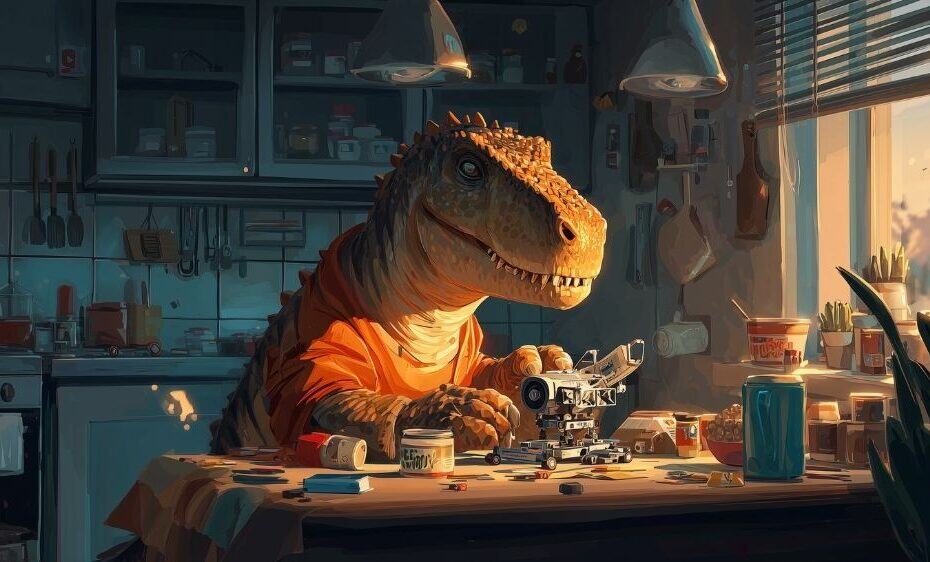
The term comes from the world of physical model-making. When hobbyists and film prop designers needed a unique spaceship, vehicle, or building, they didn’t sculpt everything from scratch. They’d buy multiple commercial model kits — a tank here, an aircraft carrier there, maybe a locomotive — and combine parts from each into something entirely new.
The Millennium Falcon? Kitbashed. The original Star Destroyer models? Kitbashed. Countless sci-fi film miniatures from the ’70s and ’80s were built this way.
The principle is simple: no single kit has everything you need, but the right combination of parts from different kits creates something better than any individual kit could produce.
That’s exactly what’s happening with your AI drafts.
How Kitbashing Works for AI Writing
Instead of asking AI to write one perfect scene (spoiler: it won’t), you deliberately generate multiple drafts, each with a different priority:
- Draft A — Structural Draft: Focused on scene architecture. Clean beats, clear turning points, solid pacing. This is the skeleton.
- Draft B — Emotional Depth Draft: Focused on interiority, subtext, and emotional resonance. This is the heart.
- Draft C — Voice/Style Draft: Focused on prose rhythm, dialogue authenticity, and tonal consistency. This is the skin.
- Draft D — Risk Draft: The wild card. Push the AI to take creative risks — unexpected metaphors, structural experiments, bold choices. This is the spark.
Each draft will be strong in its focus area and weaker in others. That’s by design. You’re not looking for four perfect scenes. You’re looking for four different perspectives on the same scene.
Then you combine them.
The Merge: Where the Magic Happens
This is where kitbashing separates itself from just “picking the best draft.”
You don’t read all four drafts and choose a winner. You read them with a priority stack — a ranked list of what matters most in this particular scene:
- What is the non-negotiable emotional beat?
- What structural elements must be present?
- What voice characteristics define this character’s POV?
- Where can you afford to take a creative risk?
Then you build the final scene piece by piece. The opening hook from Draft C because the voice is perfect. The turning point from Draft A because the structure is cleanest. An interior monologue from Draft B because it captures exactly what the character is feeling. A surprising metaphor from Draft D that elevates the whole page.
You’re not copying and pasting paragraphs. You’re selecting lines, sometimes individual phrases, based on how well they serve your priorities.
Why This Is Better Than “Just Edit the Draft”
You might be thinking: can’t I just generate one draft and edit it?
Sure. But when you edit a single draft, you’re working within that draft’s strengths and weaknesses. If the AI chose a flat emotional register, you’re trying to inject emotion into prose that wasn’t built for it. If the pacing is off, you’re restructuring sentences that were designed for a different rhythm.
Kitbashing gives you genuinely different material to work with. Draft B’s emotional depth isn’t something you had to invent — the AI already wrote it. You just have to recognize it and place it where it belongs.
This is the key insight: AI is excellent at generating variations. Humans are excellent at evaluating and selecting. Kitbashing puts each skill where it belongs.
The Beginner vs. Advanced Mindset
There’s an important distinction between beginner and advanced kitbashing that changes how you approach the technique:
Beginner kitbashing focuses on recognizing strengths. You read the drafts, notice which lines or paragraphs feel strongest, and assemble them. This alone is a massive upgrade over single-draft editing. You’re already working with better raw material.
Advanced kitbashing shifts to enforcing priorities. Instead of asking “which draft is better?”, you ask “what must win?” You define your priority stack before you start merging, and you hold the line — even when it means cutting a beautiful line that doesn’t serve the scene’s purpose.
This is the moment that separates good AI-assisted writing from great AI-assisted writing. It’s when you stop choosing and start directing.
A gorgeous metaphor that duplicates an emotional beat you’ve already covered? Cut. A perfectly smooth paragraph that slows the pacing at a critical moment? Cut. A line of dialogue that sounds great in isolation but doesn’t match the character’s established voice? Cut.
Advanced kitbashing is about editorial authority. The AI provides options. You provide hierarchy.
When You Know You’re Ready for This
Kitbashing clicks at a specific moment in your AI writing journey. You’ll know you’re there when:
- Your AI drafts are all “good” — but none of them are right
- Choosing between drafts feels harder, not easier
- You notice voice inconsistencies creeping in after revision
- Your scenes feel flat even after multiple editing passes
- You suspect there’s a better scene hiding between your drafts
If any of that resonates, you’re exactly where kitbashing was designed to help.
What This Means for Your Writing Process
Once you start kitbashing, your entire relationship with AI drafting changes:
- You stop chasing the “perfect prompt.” No single prompt will produce a perfect scene. But four focused prompts will give you everything you need to build one.
- You spend less time editing. Because you’re selecting from material that already works, your revision passes are lighter. You’re polishing, not reconstructing.
- Your voice stays consistent. When you’re the one selecting every line based on voice priorities, the final scene sounds like you — not like an AI doing an impression of you.
- You write faster. Generating four drafts takes minutes. Merging them with a clear priority stack takes far less time than wrestling with a single flawed draft.
- The technique scales. Use it for a single scene. Use it for every chapter. Use it across an entire series. The process works the same whether you’re writing 2,000 words or 200,000.
Try It for Free
The Advanced Kitbashing class at Future Fiction Academy is completely free — and it walks you through this entire process with a real scene, real drafts, and a real merge so you can see exactly how it works.
You’ll watch multiple drafts get generated with different priorities (structural, emotional, voice, and risk), then see how editorial decisions transform four good-but-imperfect drafts into one polished, cohesive scene. The class includes a downloadable handout so you can apply the technique to your own projects immediately.
Your drafts are already good. Let’s make them yours.