
Welcome to the wonderful, sometimes weird world of AI-powered writing! If you’re an author wondering how this whole AI thing works or how AI writes—or maybe you’re here because the internet keeps throwing “LLM” at you like it’s common knowledge—you’re in the right place.
At Future Fiction Academy, we believe creators need control. That means knowing exactly what AI is doing when you ask it to write a sentence, plot a novel, or finish that dialogue exchange you got stuck on at 2 a.m.
So, let’s break it down. No jargon. No fluff. Just the facts, served up with a side of pop culture references.
What Is a Large Language Model (LLM)?
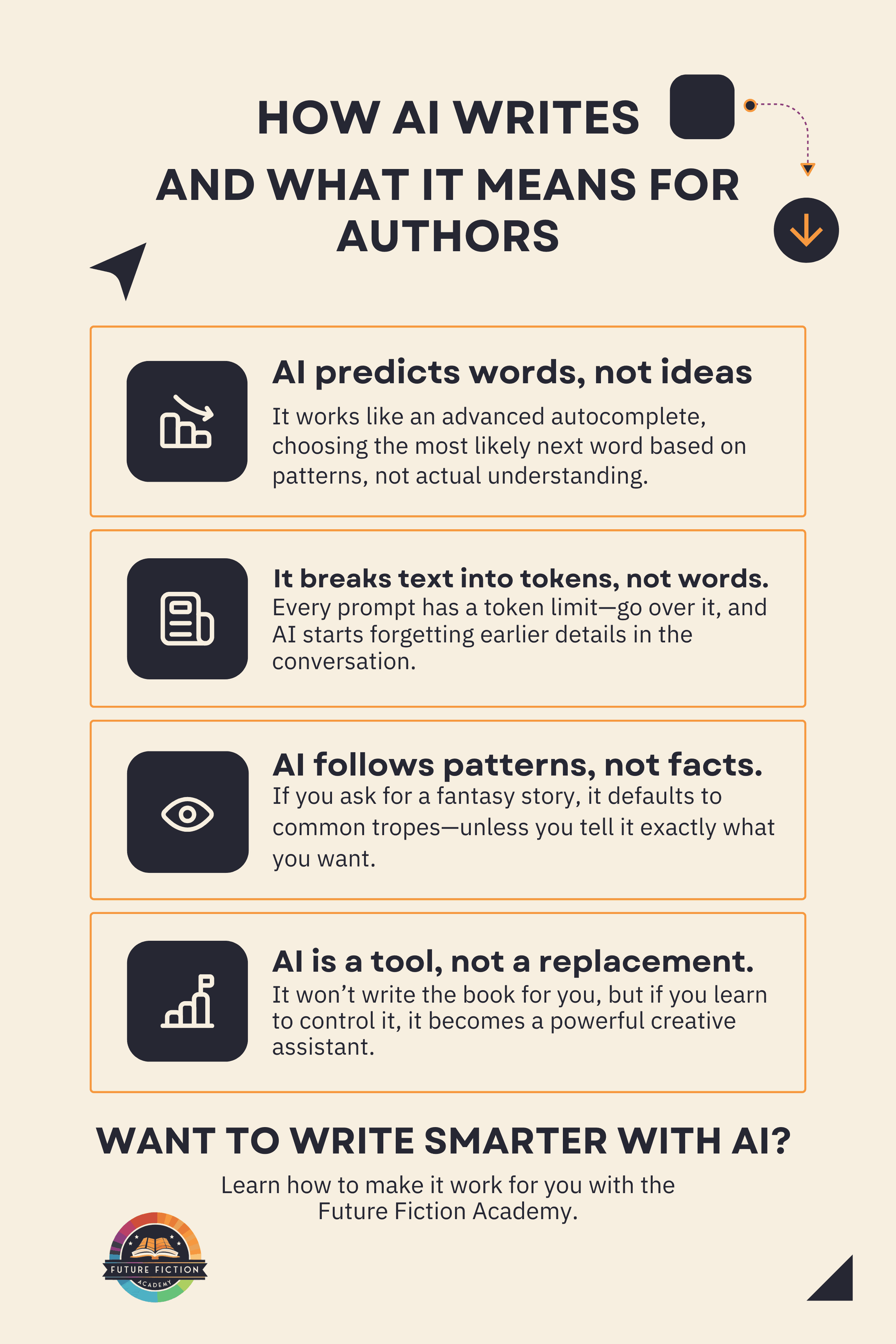
Think of an LLM like an over-caffeinated, well-read parrot. It doesn’t actually understand what it’s saying. Instead, it’s predicting what words should come next based on an insane amount of training data—aka all the text it’s been fed from the internet.
An LLM doesn’t “think” like a human. It works like your phone’s autocomplete—on steroids. You start typing “I love…” and your phone suggests “you”, “pizza”, or “lamp” (because who knows what you’ve been texting lately). LLMs do this on a massive scale, predicting the best next word over and over again until you have a full paragraph.
Why Should Authors Care?
If you know how AI thinks, you can make it work for you instead of fighting against it. You’ll know why it sometimes rambles, why it struggles with specific prompts, and how to guide it to get exactly what you want.
Imagine having a writing assistant who never gets tired, never judges your wildest story ideas, and can generate twenty plot twists in five seconds. That’s an LLM—when you know how to use it.
The Secret Sauce: Tokens
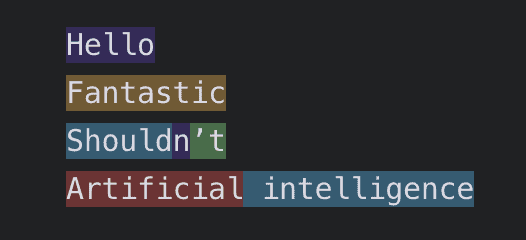
An AI doesn’t actually see words the way we do. Instead, it breaks everything into tokens—which are like bite-sized chunks of text. Some words are one token, some are two, and some (looking at you, “shouldn’t”) are split into multiple tokens.
Here’s an example:
- “Hello” → 1 token
- “Fantastic” → 1 token
- “Shouldn’t” → 3 tokens (yes, the AI breaks it into “should”, “n” and “’t”)
- “Artificial intelligence” → 2 tokens (“Artificial”, “intelligence”)
Why does this matter? Because AI has a memory limit—measured in tokens. Once you hit that limit, the AI starts forgetting the beginning of your conversation (kind of like an overtired writer who forgot what they wrote in Chapter 3).
Knowing this helps you craft better prompts and avoid AI forgetfulness.
AI Can’t Read Minds (But It Can Read Patterns)
Another key thing to remember? AI doesn’t actually know things. It recognizes patterns. If you ask it to write a fantasy novel, it’ll use patterns it has seen before—medieval settings, dragons, quests. If you tweak the way you ask, you can steer the AI in different directions.
For example:
❌ “Write me a fantasy story.” → Generic elves, swords, and castles.
✅ “Write a fantasy story set in a cyberpunk world where magic runs on electricity.” → Now we’re getting somewhere.
The more specific and structured your input, the better the output. And this is exactly what we teach at Future Fiction Academy—how to take control of AI and make it work for your storytelling needs.
Want to Try It Yourself?
If you’re ready to see an LLM in action, check out RaptorWrite—our free AI writing tool that lets you bring your own Openrouter API key and work directly with models like OpenAI, Claude, and Mistral. No middlemen, no fluff, just pure AI writing power in your hands. 👉 Try RaptorWrite here 👈